
1560A Main Street, Port Norris, NJ 08349
WEEKEND MASSSunday: 11:30 AM (2nd, 4th, and alternating 5th Sunday)
CONFESSIONsBy appointment |
MISA DE FIN DE SEMANADomingo: 11:30 AM (2º, 4º y 5º domingo alterno)
CONFESIoNesCon cita |
Parish History | Historia Parroquial
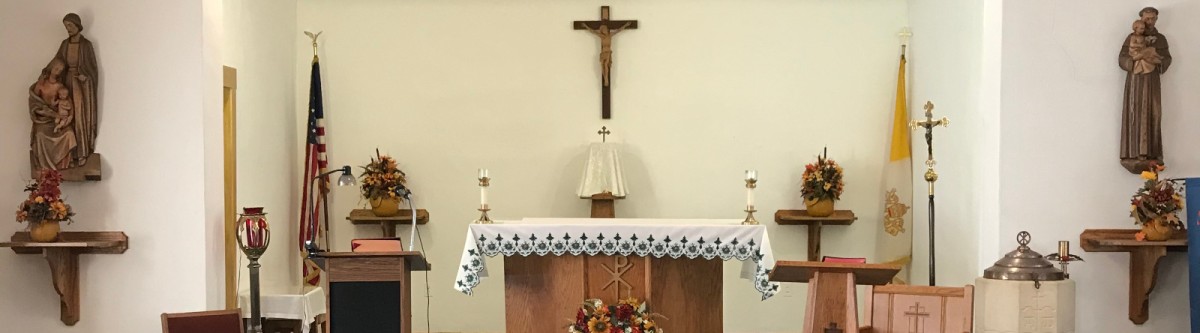
| Now, we would like to present to you, dear readers, last, but not least, the history of St. Anthony’s Church in Port Norris. Even though it is the smallest church in our parish, it is well over 100 years old and full of history.
In the early days of the 20th century, the town of Port Norris was a bustling town. It was known for its prime farmland, its shipbuilding industry at one point, but most of all, it was renowned for its thriving oyster industry. Recognizing its rich and plentiful farmland, many Italian farmers arrived at the Port Norris area from the late 19th century until the first part of the 20th century. The newly arrived Italian immigrants brought with them their extensive knowledge of agricultural skills, their culture and their Catholic religion. According to the book “The Great Wilderness” written by Margaret Louise Mints around 1968, during the first years of the 20th Century, Catholic church services were held in a private home on Strawberry Avenue which is close to the church’s current location. Mrs. Angelina Hanby, a long-time parishioner and trustee, also helped with the research of St. Anthony’s history and she revealed that eventually some of those Italian farmers got together, made up some plans, went to the Diocese of Trenton and got permission to build the church. In March 1913, plans for St. Anthony’s Church were completed and construction of the building began. Gaetano “Gus” Leonetti donated the land on West Main Street and the lumber was donated by Frank Scirotti. Some of the founders of St. Anthony’s Mission were: Gus Leonetti, Joseph Leonetti, Dominick Capaldi, Anthony DelRossi, Gabriel Gullo, Joseph Gullo and Pasquale Dagastine. The first trustees were Gus Leonetti, Dominick Capaldi, Anthony DelRossi, Joseph Lamanteer, Peter Randazzo, Dominick Damico and Carman DelRossi. The first Mass was offered by Fr. Caprezzi, and the first funeral was held for a Mr. Jack Danna. Not long after the completion of the church, in March 1915, the property and church premises were given to Church of the Sacred Heart in Vineland. It’s been exactly 100 years since the first bishop visited the Church of St. Anthony when in 1918, the third bishop of Trenton, Rev. John J. McMahan D.D. said Mass in St. Anthony’s. St. Anthony’s was under the care of Sacred Heart Church of Vineland for many years and then it was placed under the care St. Mary’s Church in Rosenhayn. The mission was civilly incorporated while under the Diocese of Trenton and during the Episcopacy of the Rt. Rev. Maurice R. Spillane on September 26, 1935. In 1952, St. Anthony’s Hall was built and given to Fr. Spofera for St. Mary’s Parish. Some of the builders of St. Anthony’s Hall included Dominick Damico, Earl Kessler, Phillip Capaldi, Sam Ricci, Tony Ricci and Joseph Dagastine. Two years after the hall was built, in 1954, St. Anthony’s was placed under the care of the new St. Michael’s Parish in Cedarville with Fr. James Gallagher as its first pastor. Soon after its merger with St. Michael’s Church, in 1955, the pastor, Fr. Gallagher, had to borrow from St. Anthony’s bank account the amount of $5,000 on February 3, 1955 in order to meet expenses for St. Michael’s Church. Over the succeeding years, the Church of St. Anthony went through extensive repairs, renovations and additions, such as the addition of a tiny side room in the 1970s. In October 2010, St. Anthony’s Church became one of five churches to merge with four more churches to create the Parish of the Holy Cross. As of today, even though it is not used as often as before, the Church of St. Anthony continues to bring the Word of the Lord to its small band of parishioners on the second, fourth and alternating fifth Sundays of the month. St. Anthony’s Church continues to be living proof of the longevity and presence of the Catholic Church even in small and remote places. |
Ahora, nos gustaría presentarles a ustedes, queridos lectores, la historia de la Iglesia de San Antonio del pueblo de Port Norris. Aunque esta iglesia es la iglesia más pequeña de nuestra parroquia, tiene mas de 100 años de antigüedad y está llena de historia. En los primeros días del siglo XX, el pueblo de Port Norris fue un pueblo con mucho éxito. Era conocido por sus excelentes tierras de cultivo, su industria naval en un tiempo, pero, sobre todo, fue muy reconocido por su gran industria de ostiones. Reconociendo sus tierras fértiles y abundantes, muchos agricultores de descendencia italiana empezaron a llegar al área de Port Norris desde los últimos años del siglo XIX hasta la primera parte del siglo XX. Los nuevos inmigrantes italianos trajeron consigo su amplio conocimiento de la agricultura, su cultura y, sobre todo, su religión católica. Según el libro titulado “The Great Wilderness” escrito por la autora Margaret Louise Mints en el año de 1968, se cuenta que las primeras Misas católicas en el pueblo se llevaban a cabo en un hogar privado en la avenida Strawberry que ahora queda muy cerca del local de la iglesia donde se ubica la iglesia hoy. La Sra. Angelina Hanby que fue una feligresa y miembro del consejo de administración por varios años, también ayudó con las investigaciones sobre la historia de la Iglesia de San Antonio y ella reveló que llegó el tiempo en que los agricultores italianos se reunieron e hicieron planos para la construcción de una iglesia, después, fueron a la diócesis de Trenton y obtuvieron el permiso para construir la iglesia. En marzo de 1913, se completaron los planos para la construcción y comenzó el trabajo de construcción. El señor Gaetano “Gus” Leonetti donó una parcela ubicada en la calle principal (West Main Street) y la madera fue donada por el señor Frank Scirotti. Unos de los fundadores de la Misión de San Antonio fueron Gus Leonetti, Joseph Leonetti, Dominick Capaldi, Anthony DelRossi, Gabriel Gullo, Joseph Gullo y Pasquale Dagastine. Los miembros del primer consejo de administración fueron Gus Leonetti, Dominick Capaldi, Anthony DelRossi, Joseph Lamanteer, Peter Randazzo, Dominick Damico y Carman DelRossi. La primera Misa fue dicha por el padre Caprezzi y el primer funeral se llevó a cabo para un tal Jack Danna. En marzo de 1915, la propiedad de la iglesia fue entregada a la Iglesia del Sagrado Corazón en Vineland. Han transcurrido exactamente 100 años desde que el primer obispo visitó a la Iglesia de San Antonio cuando en 1918, el tercer obispo de Trenton, el Rev. John J. McMahan D.D. dijo Misa en San Antonio. La Iglesia de San Antonio estuvo bajo el cuidado de la Iglesia del Sagrado Corazón en Vineland por varios años y después fue trasladada al cuidado de la Iglesia de Santa María en Rosenhayn. La misión fue incorporada civilmente cuando estaba en la diócesis de Trenton durante el episcopado de Rev. Rt. Maurice R. Spillane el 26 de septiembre de 1935. En 1952, se construyó el salón de San Antonio y fue otorgado al padre Spofera para la parroquia de Santa María. Unos de los que construyeron el salón de San Antonio fueron Dominick Damico, Earl Kessler, Phillip Capaldi, Sam Ricci, Tony Ricci y Joseph Dagastine. Dos años después, en 1954, la Iglesia de San Antonio fue puesta bajo el cuidado de la nueva Iglesia de San Miguel en Cedarville siendo el primer párroco el padre James Gallagher. Poco después de la unión con la Iglesia de San Miguel en 1955, el padre Gallagher, párroco, tuvo de pedir prestado $5,000 de la cuenta bancaria de la Iglesia de San Antonio para poder cubrir los gastos de la Iglesia de San Miguel. Al pasar de los años, la Iglesia de San Antonio fue renovada y arreglada. Se le añadió un cuarto pequeño al costado de la Iglesia en la década de los 70. En octubre del 2010, la Iglesia de San Antonio fue una de las iglesias que se juntó con otras cuatro iglesias para formar la parroquia de la Santa Cruz. Aunque ya no se utiliza tanto como en los tiempos de antaño, la Iglesia de San Antonio sigue trayendo la Palabra del Señor a su pequeña congregación cada segundo, cuarto y quinto domingo alternativo del mes. La Iglesia de San Antonio sigue siendo una prueba viviente y longeva de la presencia de la Iglesia Católica hasta en los lugares mas aislados y pequeños. |